The undergraduate Marketing programme of the Posts and Telecommunications Institute of Technology (PTIT) has been officially accredited by the Centre for Education Accreditation – Association of Vietnam Universities and Colleges (CEA-AVU&C) as meeting the education quality standards issued by the Minister of Education and Training, with 88% of criteria satisfied. The certificate is valid for the 2023–2028 accreditation cycle.
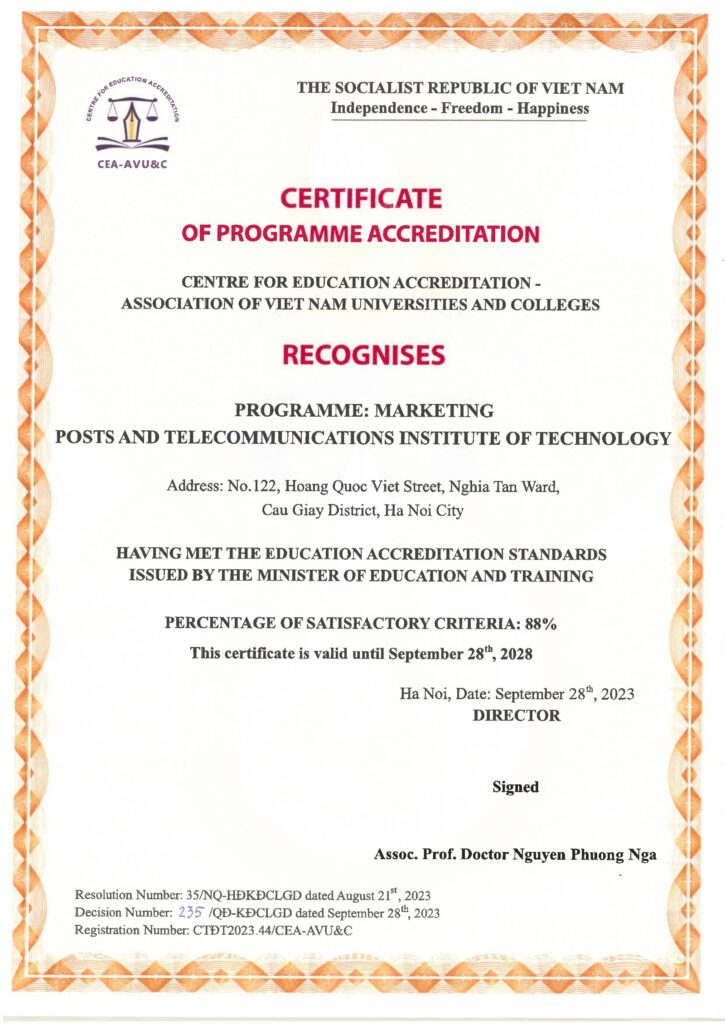
Certificate of Programme Accreditation for the PTIT Marketing programme, issued by CEA-AVU&C on September 28, 2023.
Accreditation at a glance
- Programme: Marketing (Bachelor’s level) – Posts and Telecommunications Institute of Technology
- Accrediting body: Centre for Education Accreditation – Association of Vietnam Universities and Colleges (CEA-AVU&C)
- Standards: Programme quality standards issued by the Minister of Education and Training (11 standards, 50 criteria)
- Resolution: 35/NQ-HĐKĐCLGD; Decision: 235/QĐ-KĐCLGD
- Certificate No.: CTĐT2023.44/CEA, issued on September 28, 2023
- Criteria satisfied: 88%
- Accreditation cycle: Cycle 1, 2023–2028; certificate valid until September 28, 2028
From self-assessment to external review
To reach this milestone, the Faculty of Marketing and other PTIT units carried out a self-assessment of the programme covering 2018–2023, comprehensively reviewing its objectives, learning outcomes, curriculum structure, teaching staff, teaching and learning activities, assessment methods, student support and graduate outcomes. The self-assessment report served as the basis for the independent external review.
The official site visit for the external review lasted five days at PTIT’s Hanoi campus and concluded on May 25, 2023. Alongside Marketing, the Business Administration, Accounting and Electrical and Electronic Engineering Technology programmes were reviewed in the same round. The external review panel was led by Prof. Dr.Sc. Banh Tien Long, former Permanent Deputy Minister of Education and Training.
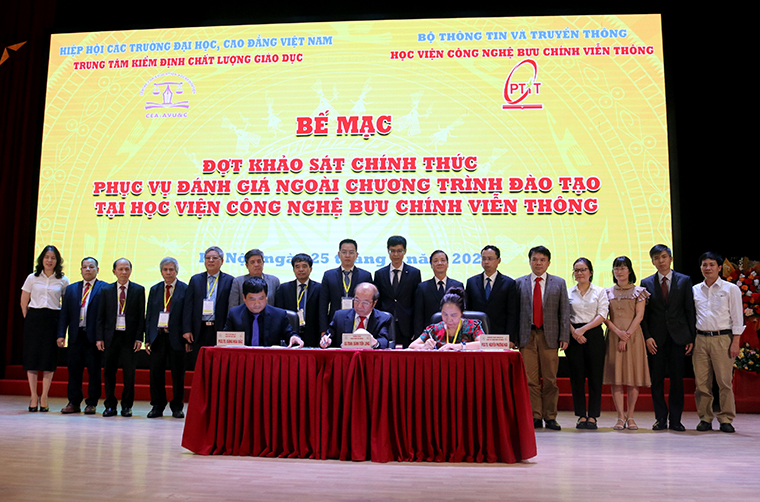
Signing of the site visit minutes for the external review of four PTIT programmes, including Marketing, on May 25, 2023. (Photo: PTIT)
At the closing session, the panel chair noted that the quality of the programmes had been clearly demonstrated across the 11 standards and 50 criteria, and urged the Institute to act decisively on the identified limitations to keep improving. On behalf of PTIT, Assoc. Prof. Dr. Dang Hoai Bac, President of the Institute, thanked the panel and affirmed that PTIT would build on its strengths while promptly implementing improvement measures.
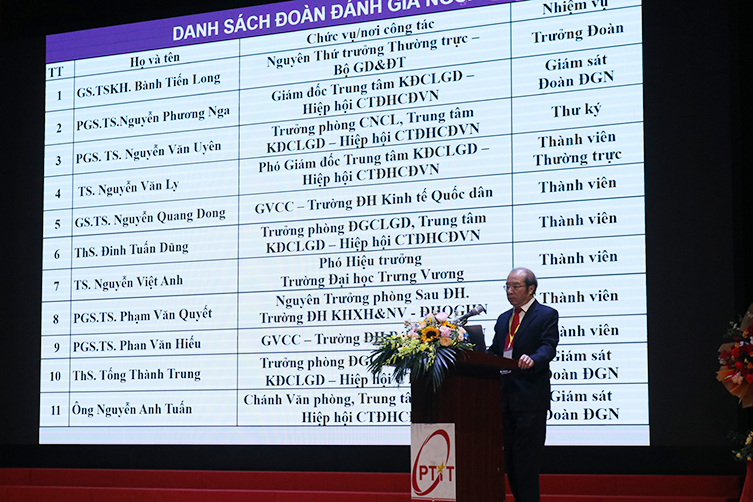
Prof. Dr.Sc. Banh Tien Long, head of the external review panel, speaks at the closing session. (Photo: PTIT)
Evidence: A programme designed around learning outcomes
A key foundation that enabled the Marketing programme to meet accreditation standards is its design and delivery under the Outcome-Based Education (OBE) model. The programme starts by gathering stakeholder needs to define its objectives and learning outcomes; it is then designed “backwards” from those outcomes, mapping a pathway for each competency and identifying the courses that contribute to it; teaching, learning and assessment methods are aligned with the outcomes; and students gain experiential learning through case studies, group-based projects and capstone projects.
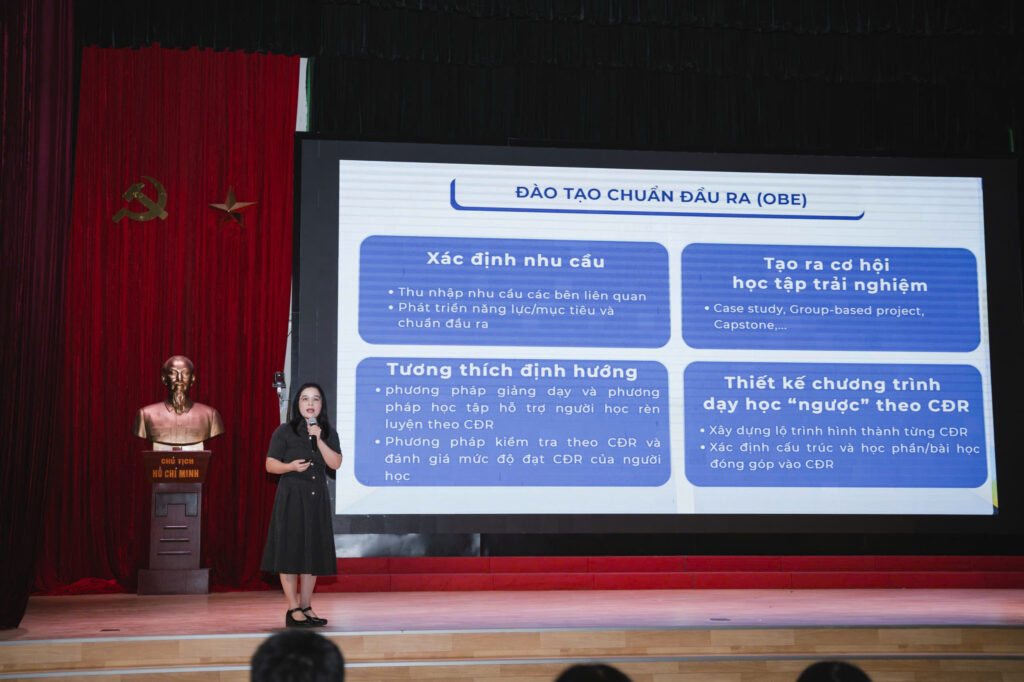
The Outcome-Based Education (OBE) model applied in the Marketing programme.
The programme defines seven Programme Learning Outcomes (PLOs) covering the core competencies of marketers in the digital environment:
- PLO1 – Knowledge: apply knowledge of basic sciences, economics, management and marketing to solve organizations’ marketing problems in a digitalized environment.
- PLO2 – Digital tools and technologies: select appropriate digital tools and technologies to analyze and solve marketing problems in line with organizational needs and goals.
- PLO3 – Thinking: apply critical, systems and creative thinking to marketing problems.
- PLO4 – Adaptability: flexibly apply marketing knowledge and skills across different industries and contexts.
- PLO5 – Communication: communicate appropriately in the marketing field for different audiences and contexts.
- PLO6 – Teamwork: work effectively in teams to solve organizations’ marketing problems.
- PLO7 – Professional judgement: make professional judgements grounded in ethics, professional responsibility and real business contexts in the digital environment.
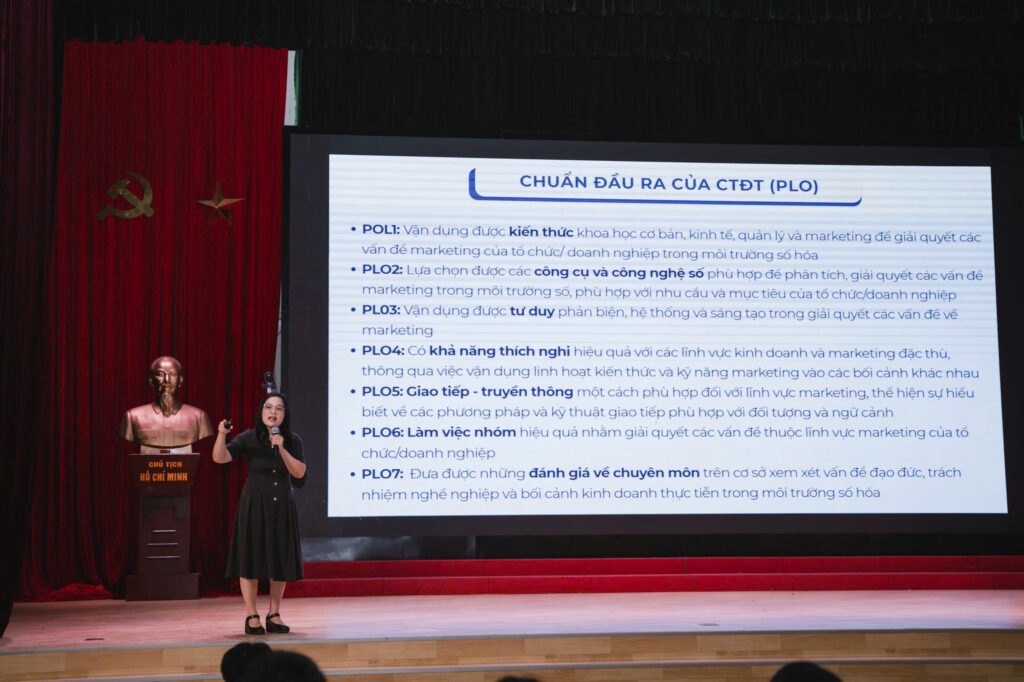
The seven Programme Learning Outcomes (PLO1–PLO7) of the Marketing programme.
In addition, the high-quality Marketing programme leverages PTIT’s strengths as a leading technology university in Digital Marketing education: more study and work in English, lecturers recognized for their expertise and teaching skills, modern facilities, partnerships with many domestic and international technology companies, and international reference materials and academic partnerships with reputable universities from the UK and Australia.
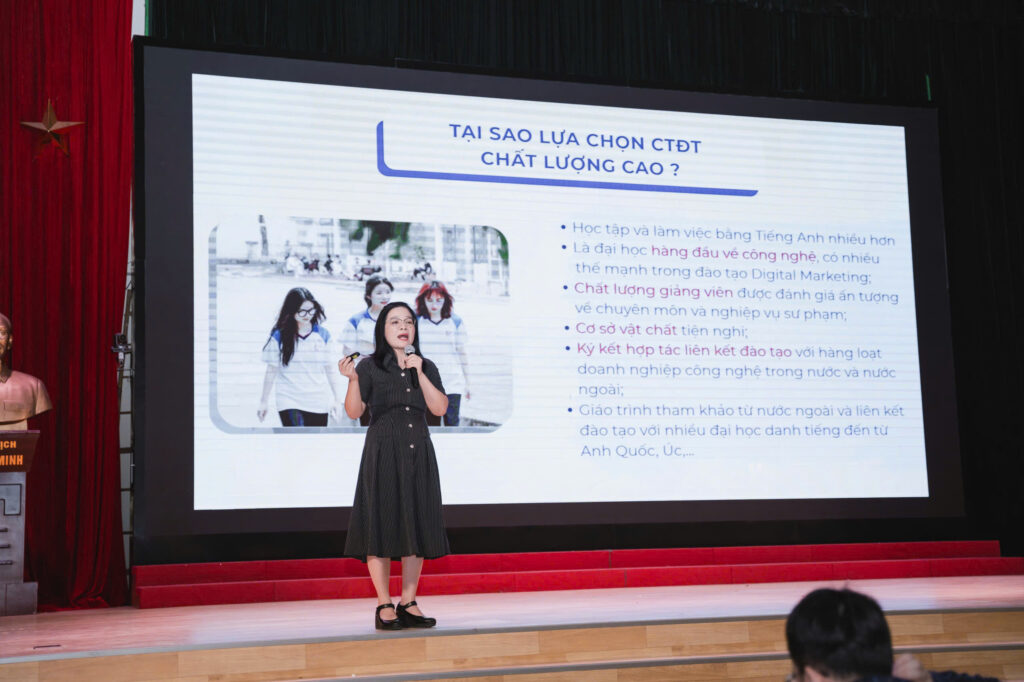
Key strengths of the high-quality Marketing programme.
What it means for students
Accreditation is independent confirmation that PTIT’s Marketing programme meets national quality benchmarks. For prospective students and parents, it is a reliable basis for choosing a programme; for employers, it assures the competence of PTIT Marketing graduates; and for the Faculty, it is a commitment to continuous quality improvement throughout the 2023–2028 cycle.
Marketing is one of 10 PTIT programmes that have been accredited, alongside Information Technology, Electronics and Telecommunications Engineering, Information Security, Multimedia Technology, Multimedia Communication, E-commerce, Business Administration, Accounting, and Electrical and Electronic Engineering Technology. PTIT has also been accredited at the institutional level.
Full accreditation results are publicly available on PTIT’s Quality Assurance and Accreditation website.
References: Programme accreditation certificate – Marketing (PDF); Closing of the official site visit for external programme review at PTIT (ptit.edu.vn, in Vietnamese).